MaxICo Labs — applied AI studio

We save your team 30-80 hours a month. Without an HR hire.

AI workflows inside your CRM, drive, and inbox. Quiet automation "under the hood" that takes the routine off people's hands: sorting leads, compiling reports, writing first-touch emails, finding duplicates. Not a chatbot on the outside — an invisible helper on the inside.

AI automation — when it works, when it doesn't.

Works when

  • Your team has 5+ people, and part of the work is copying data, setting statuses, and sending template emails.
  • Managers complain that it's "boring, the same thing over and over". That's a strong signal — the routine is systemic.
  • The business logic is stable. The "lead → qualify → task for the manager" process doesn't change every week.
  • You're ready to describe "how it works now" as a checklist or screenshots. Without that, there's nothing to automate.

Not worth it when

  • A team of 1-3 people. The overhead isn't justified — a manager can handle it.
  • The processes live "in the owner's head" and aren't formalized. First write them down, then automate.
  • A fast-shifting landscape (an early-stage startup, constant pivots). Human flexibility is better here.
  • You expect "magic out of the box". AI automation is engineering, not a miracle. Discovery takes time.

The 4 types of processes we take on most often.

Most clients start with one type — then expand to the others.

01

Lead routing + qualification scoring

A lead comes in (from a form, Facebook Lead Ads, chat, or telephony). The AI reads its data and messages → assigns a priority (hot/warm/cold) → creates a task for the manager with a ready call script → writes a first-touch message in TG/email.

Example: A design studio. 200 leads / mo. The AI splits them into "big order $10k+" / "mid $2-10k" / "small up to $2k" — each manager gets the category they specialize in.

from $1,000 one-time. Retainer (support + new rules) — from $400 / mo.

02

Document flow

Generating invoices, acts, contracts, and proposals from templates. A duplicate checker across your contact base. Auto-fill of fields from the CRM. Signing via DocuSign / Diia.Signature.

Example: The accounting team of a B2B agency. The AI pulls deal data from the CRM, generates an invoice + act per Ukrainian standards, checks the legal details, and sends it to the client with a Diia.Signature option. 30 min / document → 3 min.

from $1,400 one-time (one document type). Each additional template — +$400.

03

Reporting + analytics

Weekly reports from your CRM / ads / finance. An AI summary: "what's working, where it's failing, what to watch." Anomaly detection — if something jumps out of range (CPA doubled, conversion dropped), it alerts the manager in TG.

Example: E-commerce. Monday 9:00: the manager gets a TG message — "last week: revenue +12%, but Meta CPC rose 40% in the overnight campaigns — worth a look." With a link to the dashboard.

from $1,600 one-time. Ongoing support — from $600 / mo.

04

Custom workflow

Anything that repeats 5+ times a week and annoys the team. Pulling data from 3+ sources, sending to partners, processing forum messages and collecting feedback, monitoring competitors. We build it precisely for your task.

Example: A SaaS startup. Every morning the AI monitors 8 Reddit / HN / X threads about competitors, filters them by criteria, and drops the relevant ones into Notion with a summary and a priority for the PMO.

from $2,000 one-time. We scope the complexity during discovery.

The price list — these are floors.

The exact price comes after discovery. These are guidelines.

ConfigurationPrice (from)Timeline
One simple process (e.g., lead routing)$1,0001-2 weeks
One complex process (with 3+ integrations)$1,600-3,0002-4 weeks
Document flow (1 document type)$1,4001-2 weeks
Reporting + analytics with anomaly alerts$1,6002 weeks
Custom workflow (bespoke logic)from $2,0002-6 weeks
Retainer (support + new processes)from $600 / mostarts within a week
Discovery + process audit (paid)$4-10k2 weeks
Free 30-min audit$0after booking

* Model API costs (OpenAI / Anthropic) are separate, at cost, $60-400 / mo depending on volume. Integrations with your systems (CRM, telephony, drive) are usually free (standard APIs).

Automation in your niche looks like...

Find your industry — you'll see a typical setup.

E-commerce

Order routing: the AI splits orders across warehouses / managers by criteria (region, value, product type). Retention flows: post-purchase emails, reactivating dormant customers. A duplicate checker in the base.

40-60 hours / mo saved on admin staff

Marketing & digital agencies

This is your core working tool. AI dashboards for clients built from Google Ads / Meta / TikTok / GA4 data. CRM automation (deal statuses, payment reminders). An alternative to 5 SaaS subscriptions — one system of your own.

Replaces 3-5 SaaS tools (~$1,000 / mo saved)

Dental & medical clinics

CRM automation: calendar booking → reminders 24 and 2 hours out → no-show handling (rescheduling, follow-up calls). Document flow: contracts, informed-consent forms, discharge notes. Monthly reports to doctors on their metrics.

No-shows down 30-50%

Education & online schools

Enrollment flow: lead → trial → payment → onboarding. The AI tracks the student's progress, reminds them of deadlines, and automates issuing certificates. A reminder to pay for the next module.

Retention up 15-25%

B2B services (lawyers, accountants, consulting)

First-touch automation: an inbound lead → the AI qualifies by industry and budget → prepares a preliminary brief → sends the profile to a partner at the firm. Document flow: contracts, acts, and invoices from templates.

First-touch 3x faster

Agriculture & AgriTech

Field and harvest tracking: data from tractor and combine operators → automatic reports to the owner. Procurement (seed, fertilizer, fuel): the AI aggregates requests from the farm and builds supplier orders. Compliance reports for government agencies.

10+ hours / week saved for the office manager

[05] we live on what we sell

Our agency runs on its own automation.

MaxICo Agency uses its own products:

Trinity Runtime

A multi-agent orchestrator. Each agent owns its own part (Sales-Setter, Sales-Closer, Senior-PM, Junior-PM, Designer, Copywriter). They distribute tasks among themselves. The agency's entire day-to-day runs on it.

AgencyHub

An internal CRM with automation baked in: lead routing, document flow, reports. Instead of 5 SaaS subscriptions ($600+ / mo) — one platform of our own. Available as a product for partner agencies.

See our products →

Real automations.

All cases →

Студія вокалу / музична школа

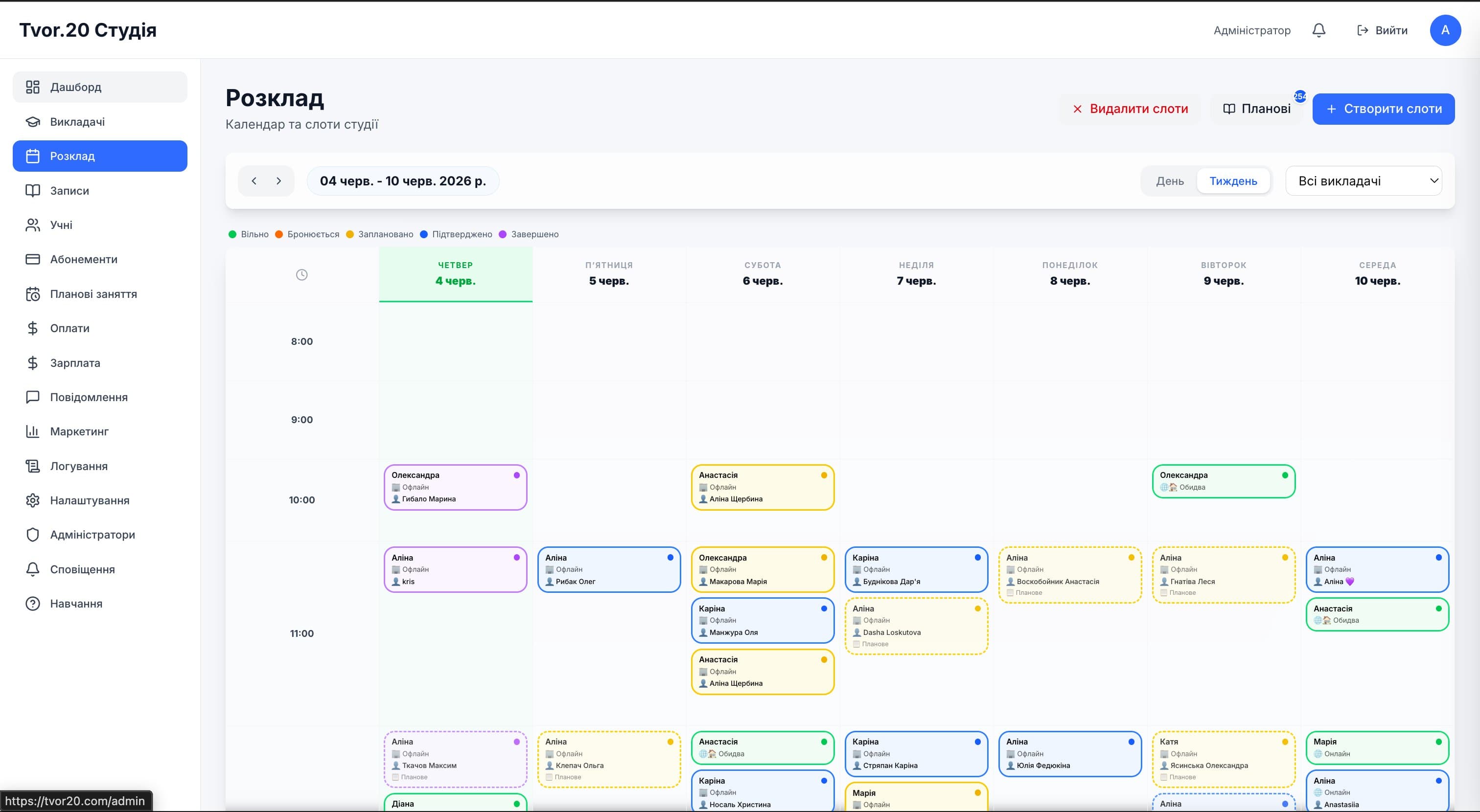
CRM для студії вокалу під ключ: уся операційка студії в одній системі — кейс Tvor.20

Студія вокалу тримається на потоці дрібних дій: бронювання слотів, скасування, нагадування, оплати, списання з абонементів, розрахунок зарплати викладачам. Поки учнів мало — усе живе в чатах і таблицях. Щойно студія росте, адмін тоне: заявки губляться, хтось не доплатив, хтось не прийшов, залишки абонементів рахуються вручну, а наприкінці місяця окрема епопея — порахувати зарплату кожному викладачу за його ставкою. Готові SaaS для музичних шкіл під конкретну студію не лягають. Інтерфейс перевантажений сотнями функцій, яких ніхто не використовує. Тарифікація йде за кожного учня або викладача, тож ~$40–200/міс ростуть разом зі студією. І шаблон не знає процесів саме цієї студії: разові уроки проти списання з абонемента, онлайн / офлайн / обидва формати, правила автоскасування, українська платіжка Monobank, робота через Telegram. Адекватної альтернативи, що поєднує весь потрібний функціонал і не дорожчає з кожним новим учнем, на ринку немає. Тому зробили свою — і покрили нею всю операційку студії, від першого запису до зарплати викладача.

But what if…

"How is this different from n8n / Make / Zapier?"+

n8n / Make / Zapier are low-code builders for simple scenarios (form → email, gsheet → slack). They work when the logic is simple and there's little data. They don't work when you need AI analysis, complex conditional logic, a large base, or custom integrations. We build in code — faster, more reliable at scale, without the platform's limits.

"What if the process changes after rollout?"+

We build in flexibility from the start. Parameters that change often go into an admin panel (you edit them yourself). Logic that rarely changes stays in code (we update it in 1-2 days on a retainer). Major changes are a separate sprint.

"Can we automate just part of the process?"+

Yes. The best approach is to take one painful spot (e.g., lead routing), automate it, confirm it works and saves time — then expand to adjacent processes. Not "one big automation from scratch all at once" — but incrementally.

"What if we have a legacy 1C / Bitrix / KeyCRM / custom-built CRM?"+

With 1C / Bitrix24 / AmoCRM / KeyCRM / HubSpot / Pipedrive / Salesforce / Monday / ClickUp — standard integrations, we've got it. A custom-built CRM comes down to its API. If there's an API, we integrate. If not, we either build an adapter or work around it via CSV exports / RPA-style.

"How do you calculate how much we save?"+

On the audit we look at 2 things: 1) The time the process takes now. "A manager spends 20 min processing a deal × 10 deals / day × 22 working days = 73 hours / mo." 2) The time after automation. "3 min to review × 220 deals / mo = 11 hours / mo." The difference × the cost of an hour = your savings. It usually pays off in 1-3 months.

"What if the AI makes a mistake and sends a client a bad email?"+

Depending on how critical the process is — three levels of protection: 1) Templates — the AI fills in only the variable fields; the skeleton is fixed. 2) Human-in-the-loop — on critical actions (sending a contract, applying a discount) the AI prepares a draft and a human confirms it with one click. 3) Logs + alerts — everything the AI did is in the logs. Anomalous behavior → an alert to the responsible person.

[08] let's talk

We'll find your "lost hours" in 30 minutes.

On the audit we walk through 3-5 typical processes of your team. We come out with a conclusion: "that's X hours / mo of routine, automatable for $Y, paying off in Z months." No commitments.

// if on the audit we see the automation won't pay off — we'll say so honestly. Better not to take on work that won't deliver a result.